


A bombardier’s legacy
A cache of old letters inspires Ross Greene
to retrace a war hero’s fatal path.
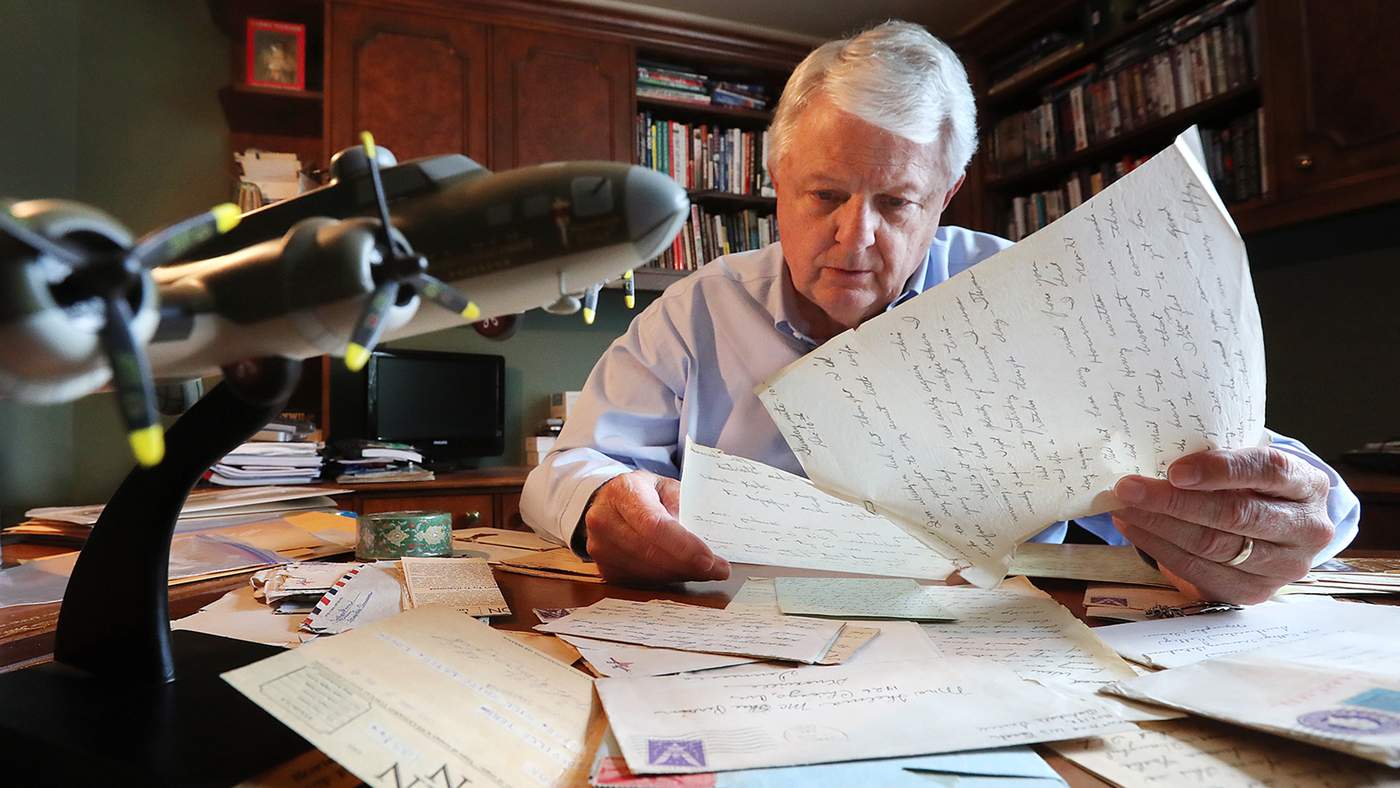

Like countless families of the 1940s, our family lost a “boy” in World War II. Our loss was 2nd Lt. Ross W. “Bud” Perrin Jr., a B-17 bombardier killed over Mannheim, Germany, on Dec. 11, 1944. Thirty-five days later, his wife Thelma, gave birth to their first-born, a daughter, Rosalind — “Roz.” I was nearly 4, the family’s first-born grandchild and his namesake. He was my beloved Uncle Bud, my hero.
Many times over the decades I have looked at a photograph taken of the two of us on his last trip home in July 1944. Wearing his Air Force crusher hat, Uncle Bud had knelt down so our eyes were at the same level. Barefooted and in my bib overalls, I snapped an airman’s salute to the smiling approval of my hero.
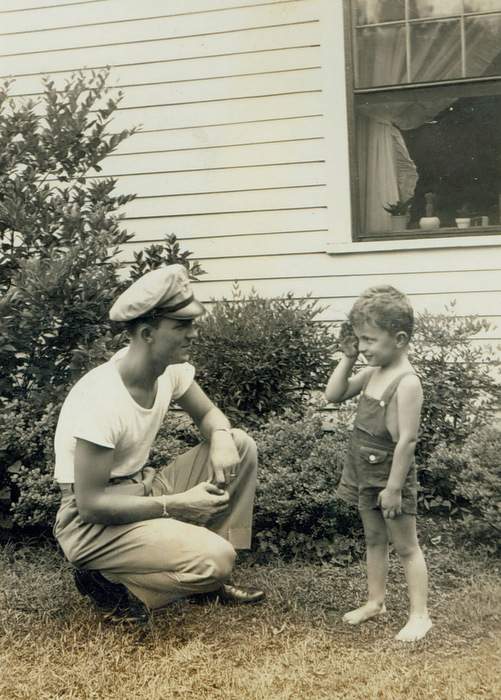
Contributed by J. Ross Greene
As children, Roz and I were close, but after college we each married, had children and moved away from our East Tennessee roots. One spring day in 2009, she called to tell me her mother, Thelma, a 1940 Miss America contestant who was now nearly 90, had suffered a debilitating stroke. Roz had gone back home to care for her.

Contributed by J. Ross Greene
“You’ll never guess what I’ve discovered in mom’s attic,” she said wryly. “About a thousand letters. They’re yellowed and fragile but in remarkably good shape for their age.”
This cache of wartime correspondence, primarily between her parents, had been stowed away gathering dust for decades.
“A number of them were from you,” she said. I recalled my mother’s steady hand helping me craft an occasional letter to my uncle Bud. “You called each other ‘Palsy-Walsy,’ do you remember that?”
The name had been hidden in the deep recesses of my mind for decades, but as she said it, my recall kicked in. What else is there? I wondered. She volunteered to send me the letters I’d written or in which I was mentioned.
When they arrived, I tore into the bulging package and read every word. Memories that had lain dormant for decades slowly came flooding back. “Mr. What,” the name of my first dog. “Ole Shooter,” my first friend.
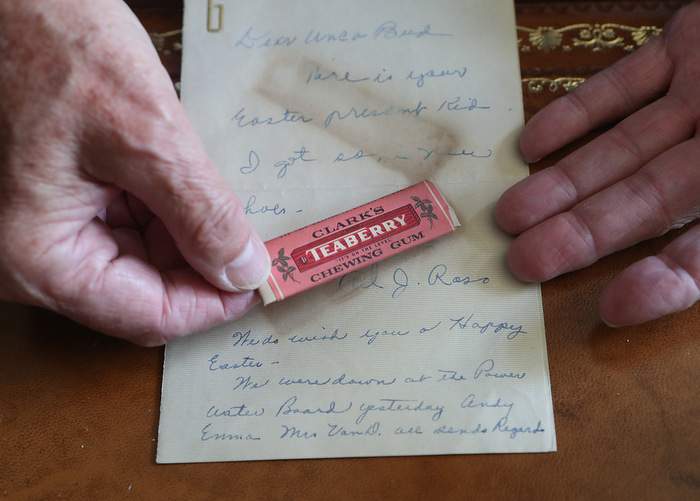
There were two letters that moved me most. In one, I had sent Uncle Bud two sticks of Teaberry chewing gum, his favorite confection and therefore mine, too. One of the pieces was missing; the other was still in the envelope. In the other, penned in the late fall of 1944, I wrote: “I want you to come home for Christmas and I’ll never let you go away again.” If only he had. I stared at those words for some time.
A few weeks later, Roz sent me a disc containing scans of the remaining letters exchanged between her parents. I spent a week lost in the reverie of discovery. The magnitude of information revealed in the letters was overwhelming. They enumerated the details of Army Air Corps training and Bud’s frustration with the “hurry up and wait” attitude so prevalent in the service. They also revealed the emotions and concerns of a young couple who, like thousands of others, had to put their life plans on hold because of the war.
“After a very slow start, I got in seven missions in the first month,” Bud wrote on Sept. 29, 1944. He was required to complete 35 missions before he could return home. “At this rate I could be home before Junior is born — if you can hold off ‘till late January. No pressure, just have a healthy one — boy or girl. I’ll be home as soon as I can. I love you more than I can really express.”
When Uncle Bud died, I was told about it, of course, but I got few details and was considered too young to attend the funeral after his body was returned to the States in spring 1949.
On Saturday mornings for about an hour, I was allowed to play with his service medals and Purple Heart at Granny Perrin’s kitchen table. She would remove them from a circular powder box, and I would line them up in rows and move them around, driven by the desire to touch them and ponder what each of them signified. Granny Perrin would sit at the other end of the table and occasionally tears trickled down her wrinkled cheeks. I have the medals now. I still keep them in the same box, which has lost none of the beautiful fragrance of powder.

As time passed, our family talked about Uncle Bud less and less. I held on to a few vivid memories and treasured photos, and struggled silently with questions I was too afraid to ask. How did he die? Was he shot? Did he die in the air? Did he bail out? Did the plane crash?
Now, six decades later, this treasure of correspondence rekindled my curiosity and stirred unresolved emotions I had buried since the day I learned Uncle Bud died. I decided I had to learn everything I could about Bud’s service to our country and his death. I wanted to help Roz get to know the father she never knew. And as one of the few people still living who knew Uncle Bud, I wanted to capture his story before it was too late.
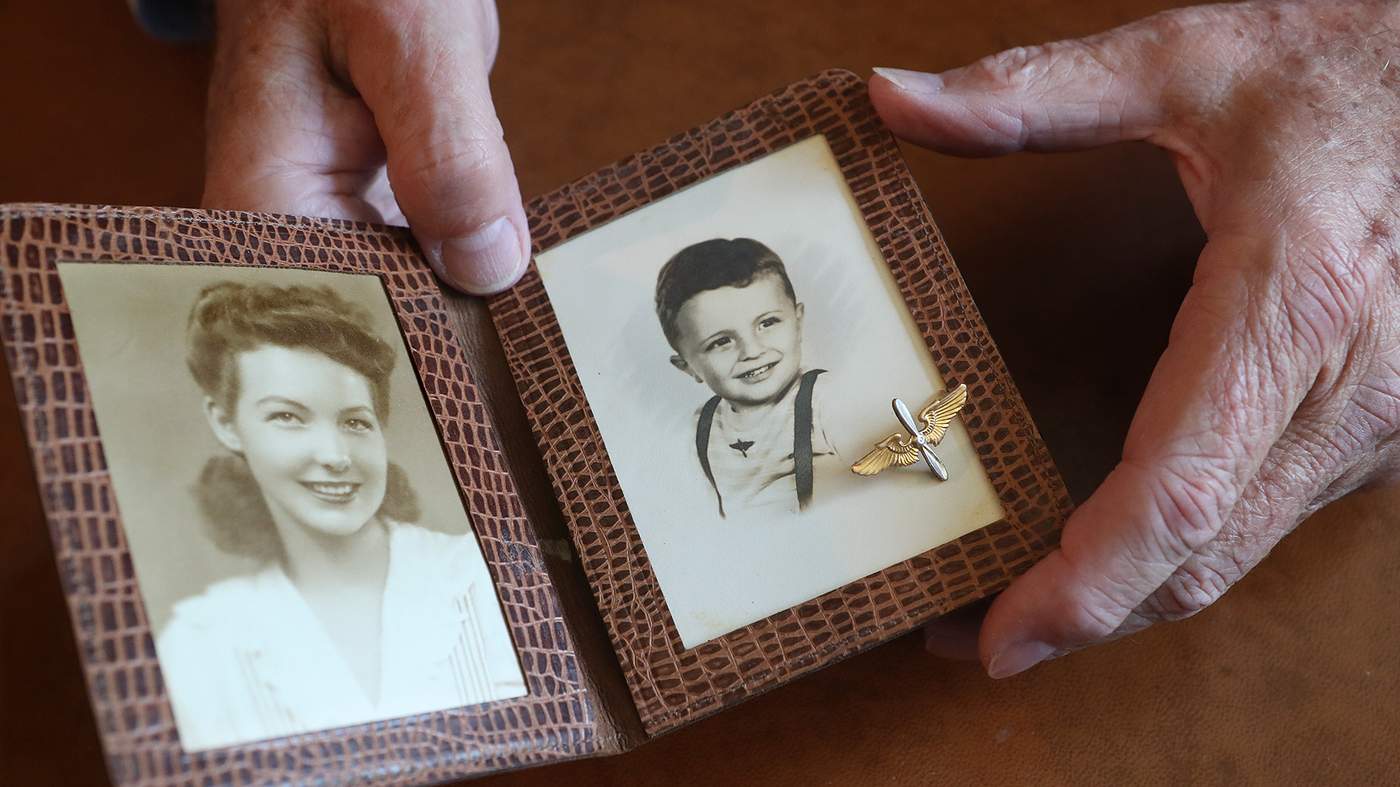
Greene holds a set of photographs of himself as a child and his Uncle Bud's wife Thelma.
3
Missing in action
As the sun set behind the trees encircling what remained of the Ridgewell Aerodrome, my mind traveled back to that night of Dec. 10, 1944, when my uncle wrote his last letter to his wife.
“I’m already in bed, but thought I’d like to say goodnight to my sweet little wife before going to sleep. Didn’t write yesterday because I was too tired after a rather tough day — it was long anyway. Still didn’t have any mail from you since last Monday. Now Sweetheart, if you don’t mind, I’ll stop this letter short and try to get some shut-eye. I love you baby, an awful lot — think of you constantly. Goodnight — Bud.”
Before daybreak the next morning, he boarded a new, unnamed B-17, in preparation for his 15th mission into the belly of the Reich. Shortly after noon, while on the bomb run, flak struck engine No. 2 and his aircraft plummeted earthward from its two-mile bombing altitude and crashed in a vacant field in Mannheim-Neckarau, Germany.
Back home, life went on as normal amid the uncertainty and inconsistency of wartime communication. Letters were written to Bud from family members, but none were answered. Twenty-two days after Bud’s plane crashed, two Air Force officers arrived on Thelma’s doorstep and delivered a missing-in-action telegram. A few days later, a telegram arrived that said, “Report now received from the German government through the International Red Cross states that your husband 2nd Lt. Ross W. Perrin Jr. who was previously reported missing in action was killed in action on eleven December over Germany. The Secretary of War extends his deep sympathy.”
Thirty five days after her father’s plane crashed, Rosalind, was born.
The mission in which Uncle Bud was killed was the largest air strike by the 8th Air Force at that time. The skies were saturated with 2,400 aircraft that day, including 1,600 bombers. One of the targets was the Mannheim-Ludwigshafen bridge (now the Konrad Adenauer Bridge) connecting the critical German BASF chemical plant with rail yards across the Rhine in Mannheim. Only 14 planes were lost that day, less than one-half of 1 percent of the total strike force. One of them was Uncle Bud’s.
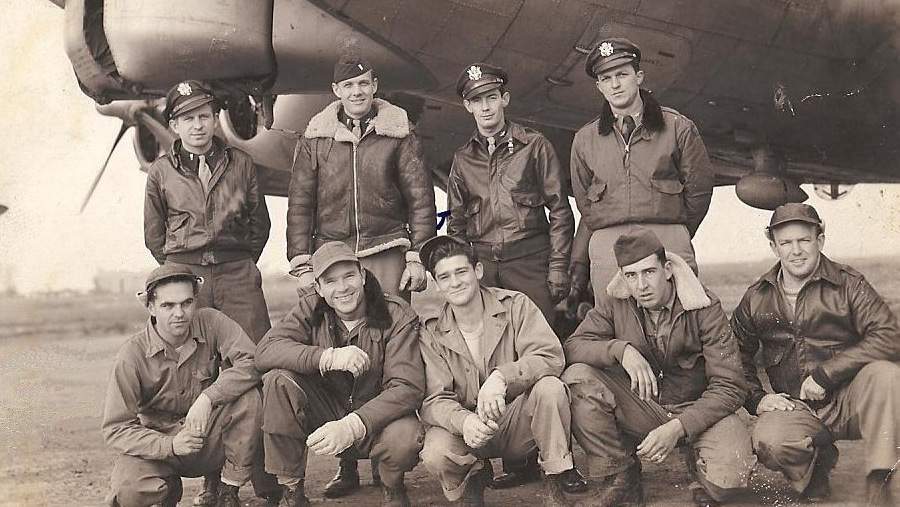
Bud’s crew, pictured in October 1944, was based in Ridgewell, England. He is standing top right. Contributed by J. Ross Greene.
Thelma and Bud weren’t married long, but the power of their love survives in the letters they exchanged during his service to our country. Contributed by J. Ross Greene


ABOUT THE STORY
To piece together the story of his uncle’s military service during World War II, Ross Greene spent years combing through volumes of government records, war diaries and mission documents, and he toured numerous museums and air fields. He interviewed more than 200 WWII veterans, some of whom had trained and served with his uncle, as well as historians, authors and researchers. He chronicled his journey in a book titled “A Fortress and a Legacy: The Gift of a WWII Bombardier’s True Story to the Daughter He Never Knew.” (For information, go to afortressandalegacy.com.) It is a story of family devotion and the legacy of loss. And it is a reminder of what we owe those who serve our country as we approach Veterans Day on Nov. 11.
Suzanne Van Atten
Personal Journeys editor
personaljourneys@ajc.com

ABOUT THE WRITER
J. Ross Greene has a background in engineering and a 40-year career in the investment industry with his own consulting firm. He is the author of “A Fortress and a Legacy: The Gift of a WWII Bombardier’s True Story to Daughter He Never Knew.” He and his wife Lynne live near Atlanta. They have three children and eight grandchildren.

ABOUT THE PHOTOGRAPHER
Curtis Compton joined the AJC as a photo editor in 1993 before returning to the field as a staff photographer. Previously he worked for the Gwinnett Daily News, United Press International and the Marietta Daily Journal. He has a bachelor’s degree from the University of Georgia and won a World Hunger Award for his coverage of the famine in Sudan.
Please confirm the information below before signing in.