


From pain, a purpose
Dorsey Jones survived the horrors of child sex
trafficking to become a source of hope for troubled youth

3
World of opportunity
“My name’s Dorsey Jones,” said the unexpected visitor, as summer wound down in 1992, “and I want to be a student here.”
She was speaking to Chris Andrews, a Morris Brown College admissions representative, in his office. What he didn’t know is that Dorsey had been tracking his boss, noting what time he went to lunch. She’d walked several miles from Job Corps six straight days trying to gain admissions to the school. Andrews’ boss had glanced at Dorsey’s high school GPA, a low D average, and all but laughed in her face.
But now the boss was out to lunch, and Andrews was different. He could sense doggedness and determination in Dorsey, a fire flickering. “I was always told I was nothing, that I wasn’t going to be nothing in life,” Dorsey told him. “The odds are against me.” Andrews agreed to phone her high school guidance counselor.
When Andrews hung up, he told Dorsey she’d be admitted on probation. She fell to her knees, thanking God.
It was the first in a series of remarkable favors — the work of Dorsey’s angels, she says — that propelled her through college. A housing director let her sleep in an unoccupied dorm room secretly for free. A cafeteria worker spotted her smelling the food and walking away. Without a meal plan, Dorsey was allowed to eat breakfast and dinner.
With the help of a math tutor, Dorsey excelled in classes, tapping the potential that was always there but imprisoned by need. Inspired by a professor and her past struggles, she chose criminal justice as a major.
On a whim, Dorsey nominated herself for vice president of Student Support Services. To campaign, she had to give a speech, so she combined phrases from a local TV commercial and hip-hop lyrics. Before an auditorium crowd, she bellowed: My name is Dorsey Laquan Jones, and I’m from Bainbridge, Georgia. You can get with this, or you can get with that. For determination, get with this. For dedication, get with this. For dependability, get with this. You can get with this, or you can get with that, but I’m telling you, this is where it’s at!
She won in a landslide. Clearly, she had a knack for motivating crowds from podiums.
That fall Dorsey crossed paths at school with a handsome male student. Carlos Cook was a dapper therapeutic recreation major from Columbus. They exchanged pleasantries. Afterward, whenever they passed on campus, he asked for her phone number. Each time, Dorsey declined, wanting nothing to do with another man. Finally, after a year, they were both in a gym class; he politely asked again for her number, and she acquiesced. They spoke on the phone until 3 a.m. that night and have been together since.
A few months later, Dorsey returned to Bainbridge for a visit and took Carlos with her. She missed the people who’d helped her, and she wanted everyone to see how her life was stabilizing, how a good man could want her.
As they were driving back to Atlanta through a thunderstorm on Ga. 27, Dorsey told Carlos, I have something to tell you. If you decide to leave me, that’s OK, because everybody that was important in my life left me, and I can handle it.
For the first time, Dorsey told her story. While she was speaking, Carlos pulled the car onto the shoulder of the road and embraced her.
It’s OK, Carlos said. You did what you had to do to survive.
The following October, after Carlos graduated and took a job with the U.S. Postal Service, they welcomed their first child, a daughter, Malia. That same month, Dorsey was back in class. Again, her angels stepped in. Five women in the financial aid department took turns caring for the baby in a carrier under their desks. Dorsey married Carlos in 1996 and graduated with just shy of a 3.0 GPA.
For a while, Dorsey earned her spurs working as a security guard. Then a friend recommended straight-laced, no-nonsense Dorsey as a candidate for Fulton County Juvenile Court probation officer, policing the behavior of wayward youth and helping them get right.
That career lasted 13 years until an encounter with a young girl changed the course of Dorsey’s life, making her nightmarish past public in way she could have never predicted.
5
New-found purpose
Georgia ranks among the country’s top 10 states in terms of human trafficking. Look at a heat map of where reported cases occur within state lines, and metro Atlanta is a disproportionately huge red welt. With its web of interstates, global airport, billion-dollar convention and tourism industry and a thriving strip club scene, Atlanta is the Southeast’s dubious capital of a seedier sort of trafficking.
Experts estimate that 9,100 transactions occur per month in the metro area. About 250 girls and 50 boys in the area are currently being victimized.
“I know for a fact the number of children who are being victimized by this is exponentially more than the cases we’re able to prosecute,” said Chuck Boring, Cobb County Deputy Chief Assistant District Attorney and member of the state’s human trafficking task force.
Four stories of brick and glass, the Judge Romae T. Powell Juvenile Justice Center looms over the I-75/I-85 Connector. In the fight against exploited kids in metro Atlanta, this is the front line. Dorsey works in a corner office, in what they sarcastically call “the penthouse.”
At the juvenile justice center, take the elevator to the second floor, walk a long, carpeted hallway with shoe-scuffed walls and placards that read “Mental Health Unit” and “Probation Services,” open the door to YouthSpark, and the change of scenery is dramatic.
Beneath a chandelier, YouthSpark is all bright walls, white cabinetry, huge flat-screen televisions, cozy mid-century modern couches and lounge chairs, and a pantry stocked with toiletries and free food — piles of Fritos and Nature Valley granola bars and much more.
“This is every child’s dream when you are poor and you have nothing,” said Dorsey.
Her volunteering gig transitioned into a full-time job as a case manager with YouthSpark in March. The nonprofit was founded in 2000 and once offered the Southeast’s first safe house for exploited girls. Back then victims were being arrested and charged as prostitutes; today they’re viewed as victims and diverted to YouthSpark for intervention services. Boys and LGBTQ youth are welcome now, too. The program helps about 40 victims per year. Average age is 16.
Swain, now Dorsey’s boss, had high praise.
“Since she’s been on our team, we’ve had girls disclose trafficking and exploitation faster than we’ve ever had in this program — and we directly attribute that to Dorsey looking at them, and sharing and giving of herself, and her story,” Swain said. “I mean, she’s a mom. She’s a wife. She’s a survivor. She’s so many other things beyond being a victim. Her perseverance is contagious.”
Wearing a frayed denim skirt, pink Chucks and a maroon faux hawk, Dorsey joins the girls in the meeting room for group therapy. There they feast on fried chicken, pizza, lasagna, greens and rolls while they engage in art therapy or watch educational presentations on the 62-inch TV. Sometimes they just talk and cry.
The girls are black, white, Asian, Puerto Rican, from the suburbs and the city. They look up to her and call her “Miss Dorsey.” They say she’s “lit.”
During our first meeting, I wanted to ensure that asking Dorsey a bunch of questions about everything wouldn’t drudge up emotional distress. So I asked if it would be OK to ask — and Dorsey ignited. Her voice dipped, as it does when she’s inspired, into the low guttural passion of a blues singer:
“Let me tell you this, I don’t want you to think that I’m sitting here crying. I have cried enough. It’s not about me anymore. It’s about the children and women and boys that are going through this. It’s just time to annihilate it — to eradicate what’s going on. If you need to ask me something, now’s the time to ask. You can’t make me feel no kind of way, I promise you.”
But some promises break.
7
The mission
It was the summer’s biggest event, and Dorsey’s “glam squad” was swarming.
That’s the team that accompanies her to engagements like Atlanta’s Rotary International Convention, a gathering last month at the Georgia World Congress Center focused, in part, on human trafficking. There, Dorsey was flanked by attendants for her hair, wardrobe and makeup, plus a project manager, photographer and her manager, Lee Summers-Garner, who arranged the team that provides their services pro bono.
Beyond Dorsey’s table and a banner with her face on it, men and women of all ages and many races lined up to pay $20 for her book, maybe grab a photo and a hug.
In her green ruffled shirt, palazzo pants, Kenneth Cole heels and gold hoop earrings, Dorsey looked positively glamorous. But her quiet demeanor suggested she wasn’t lapping up the attention so much as tolerating it for the cause.
Suddenly, it was show time. Dorsey shot into a cavernous ballroom.
During a thundering video introduction projected on three giant screens, Dorsey was in full serious mode as she decried the “epidemic” of modern-day sexual slavery. The audience politely clapped.
Then Dorsey took a seat on a four-person panel. Her co-presenters held senior positions with The Carter Center, the Polaris Project and the U.S. State Department’s Office to Monitor and Combat Trafficking in Persons. Dorsey’s title was simpler: survivor.
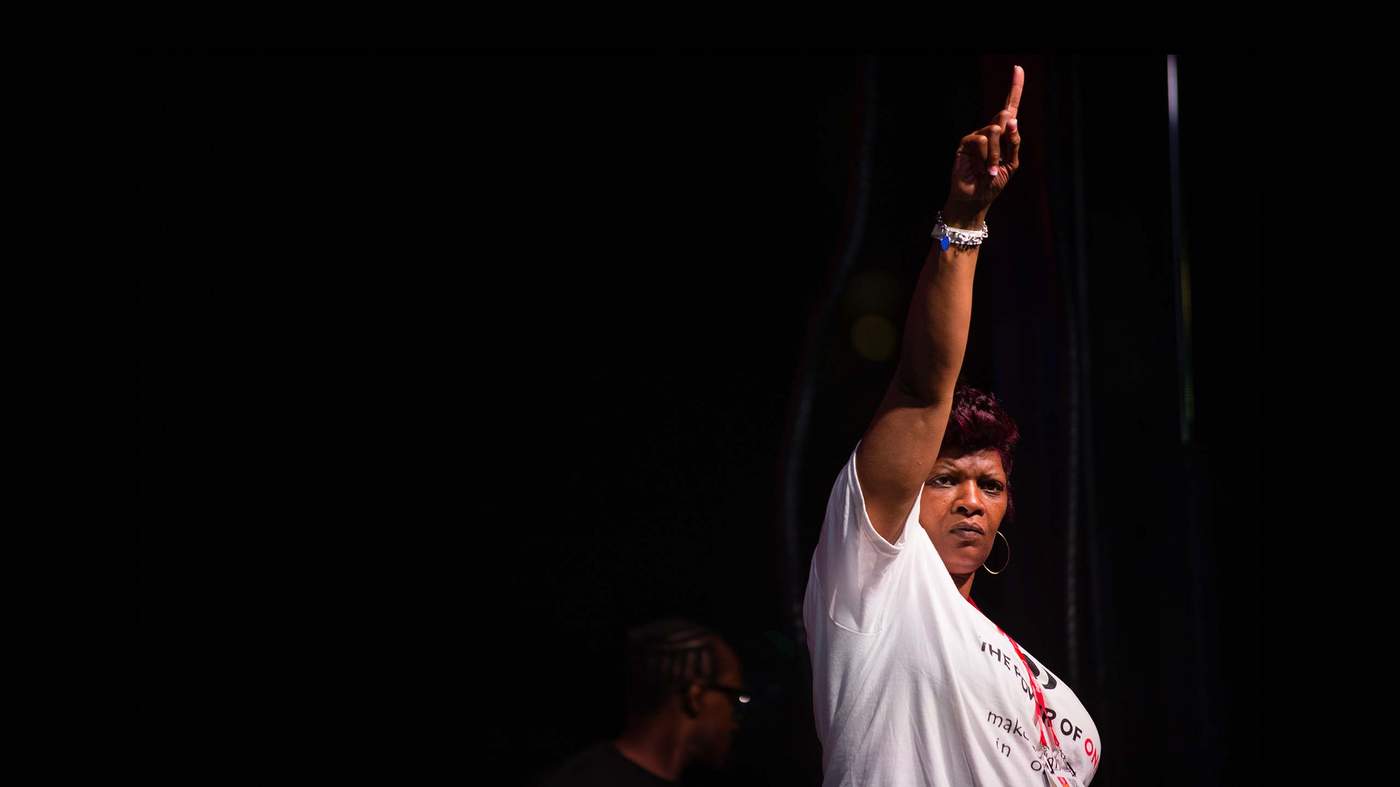
After the others had spoken from their seats on the dais, a cold focus came across Dorsey’s face. She stood up and marched to a podium beside the fern-girded stage, and she launched into an emphatic, unscripted telling of her story.
Rotarians visibly winced. They shook their heads. At one point, they cheered. For the finale, Dorsey grew loud:
“I am going to be the voice for the voiceless. I’m going to be the hope for the hopeless. And I’m going to stand up for every child … who cannot stand up for themselves.” Dorsey snatched the Rotary gavel used for official meetings and waved it high. “So today I come, and I hit the gavel” — CRACK! across the wood podium — “and I ask you to fight for the children here, across this globe. Thank you!”
A generous applause, within seconds, became the roar of a standing ovation.
Outside the ballroom, as admirers queued for autographed books, Dorsey wore a devious smile and said the bit with the gavel hadn’t been planned — she’d gotten a little carried away in the moment — and the contrast between her and the lost kid in Bainbridge couldn’t have been more stark.
Gone was the girl who once thought of herself as Humpty Dumpty, a girl so far broken she couldn’t be fixed. The girl who once walked into a mental health clinic, but didn’t know how to ask for the help she needed. The girl who was desperate for a place like YouthSpark but couldn’t find it.
In her place was a woman with a purpose and a family who supports her mission, a woman who views her life not as a traumatic experience but an unfolding journey that is absolutely amazing.
Dorsey gathers with her family, daughter Malia Cook (from left), son Alston Cook, Dorsey, husband Carlos Cook, daughter Ayanna Cook, and son Malik Cook in the their Hampton home.


ABOUT THE STORY
Immersing oneself in the sordid world of child sex trafficking isn’t for everybody, but Josh Green has been wanting to tell this story since his days covering the crime beat for a daily newspaper. To tell this story he interviewed Dorsey Jones at her home, office and at her former college. He spoke to her colleagues, family and fourth-grade teacher, who studied Dorsey’s home environment as part of a master’s thesis. And he spoke to experts on Atlanta’s sex trafficking problem. Josh said the assignment was among his most challenging — with some of the hardest interviews — of his career. We’re glad he did it, though. It’s an important story and it needs to be told.
Suzanne Van Atten
Personal Journeys editor
personaljourneys@ajc.com

ABOUT THE REPORTER
Josh Green is a freelance journalist and fiction author who lives in Atlanta with his wife and daughters. His work has won top accolades in his native Indiana and in Georgia, where his 2016 Atlanta magazine story on gentrification won Atlanta Press Club and Green Eyeshade awards. A contributing writer at Atlanta magazine and editor of Curbed Atlanta, Green is working with his literary agent to submit his first novel to publishers. His book of short stories, “Dirtyville Rhapsodies,” was published in 2013.

ABOUT THE PHOTOGRAPHER
Bita Honarvar is an Atlanta-based photographer whose work has appeared in the New York Times, Guardian US, Chicago Tribune and The Atlanta Journal-Constitution, where she was a staff photojournalist and photo editor for 16 years. Her work has taken her around the United States and abroad, including stints in Afghanistan, Iraq and Iran.
Please confirm the information below before signing in.