


Healing touch
A mysterious illness changes the course of a hospital chaplain’s life.


The woman sat in Harvard Square. Hunched over in a wheelchair, she barely registered the late autumn sunshine and bright fall colors. Her black braids tumbled loose and her sweatshirt hung shapeless on her thin body. As a newlywed, she should have been vibrant and sparkly-eyed, but she was tired and grumpy. She felt like a burden to the man she loved, who would soon come and wheel her home after his law school class.
She lifted her head and spotted a young woman walking briskly through the square. The woman wore a red plaid poncho, and her sleek dark hair shone in the sunlight. A smile lingered on her glossy lips. Without warning, the smiling girl broke into laughter and twirled in place, her arms outstretched wide, as if she relished being alive on such a gorgeous day.
Rage and grief rushed through the woman in the wheelchair.
How can that girl take up so much sky? she thought to herself as hot tears welled up.
The daughter of a Navy navigator, Amani Brown lived in nine states before her family settled in Atlanta in 1990 when she was a teen. Her mother, a clinical psychologist, provided mental health services to marginalized and underserved populations.
Amani was one of those super-bright over-achieving kids who finished high school early. She entered Amherst College at 16 and won a prestigious Howard Hughes Fellowship in Science.
Science was her passion. Answers to the big questions in life were to be found in its systematic scrutiny. The path lay clearly ahead of her: After Amherst, she would attend Harvard Medical School and devote her life to healing others.
It might have happened just that way. Except that at age 24, she became the girl in the wheelchair.

3
Tools for healing
Schooled in the sciences, Amani had always been committed to traditional Western medicine, despite its failure to help her.
She knew there were people who, when their bodies show signs of disease, might have their muscles massaged with hot stones, their backs aligned by a chiropractor, their neural pathways needled by an acupuncturist, their oxygen levels amped up in a hyperbaric chamber, their chakras analyzed and balanced.
Amani was not one of those people.
But her trust in traditional medicine began to waver. She had all the symptoms of traumatic brain injury and stroke, but the precipitating incident was unclear. No car accident or massive blow to the head. Just that head bump at Amherst. Regardless of the diagnosis, no doctor could offer her a prognosis.
“I was so frustrated. I could not imagine living the rest of my life like this,” she says. “I wanted energy. I wanted to walk.”
Out of desperation, Amani allowed a friend to talk her into seeing a man named Peter Churchill, who called himself a healer, a shaman. Amani recoiled at the very words. He was trained in cranio-sacral therapy. Many consider it a pseudoscience, but practitioners of the subtle massage technique believe it heals many ills by enhancing the flow of cerebral spinal fluid.
Peter and his wife, a registered nurse and acupuncturist, practiced in an old house outside Cambridge filled with “healing rooms” where home births occurred and drumming parties were held at the Solstice.
“I absolutely did not trust these people,” said Lionel. “I’m the more skeptical one in the relationship.”
Initially he sat in on the sessions as Peter worked on straightening Amani’s neck, which had become perpetually twisted in a way that forced her chin toward her chest at an uncomfortable angle. Slowly over time, her neck began to straighten. Her thoughts became clearer as a result. She was pleasantly surprised. So was Lionel, who supported whatever was making her better, stronger.
“What I really appreciated, said Amani, “is that Peter believed I was sick!”
She began to explore other alternative avenues of healing, and session by session, Amani began to get better.
She underwent acupuncture and reiki, a healing technique in which practitioners believe their touch can channel energy in a patient’s body and activate healing. She participated in drumming circles and drank boiled herbs and bug carcasses she got from a Chinese herbalist.
“It smelled so disgusting,” she said. “I would just innocently shrug when my neighbors asked where ‘that smell’ was coming from.”
And she also leaned on the prayers of friends and family. As her faith in traditional medicine waned, her faith in God grew stronger.
Was it the placebo effect? Did she improve because she believed in it, or did these ancient healing methods actually bring relief? She only cared that she got stronger every day.
“I think I resisted healing for a long time,” says Amani. “I wondered if I was worthy of it. I had to let go and allow healing to happen.”
A year after she began her treatment regimen, Amani was still weak, but she was out of the wheelchair and back in divinity school. She also had a new perspective: Science was no longer infallible; it provided a tool for healing, but it was one of many.
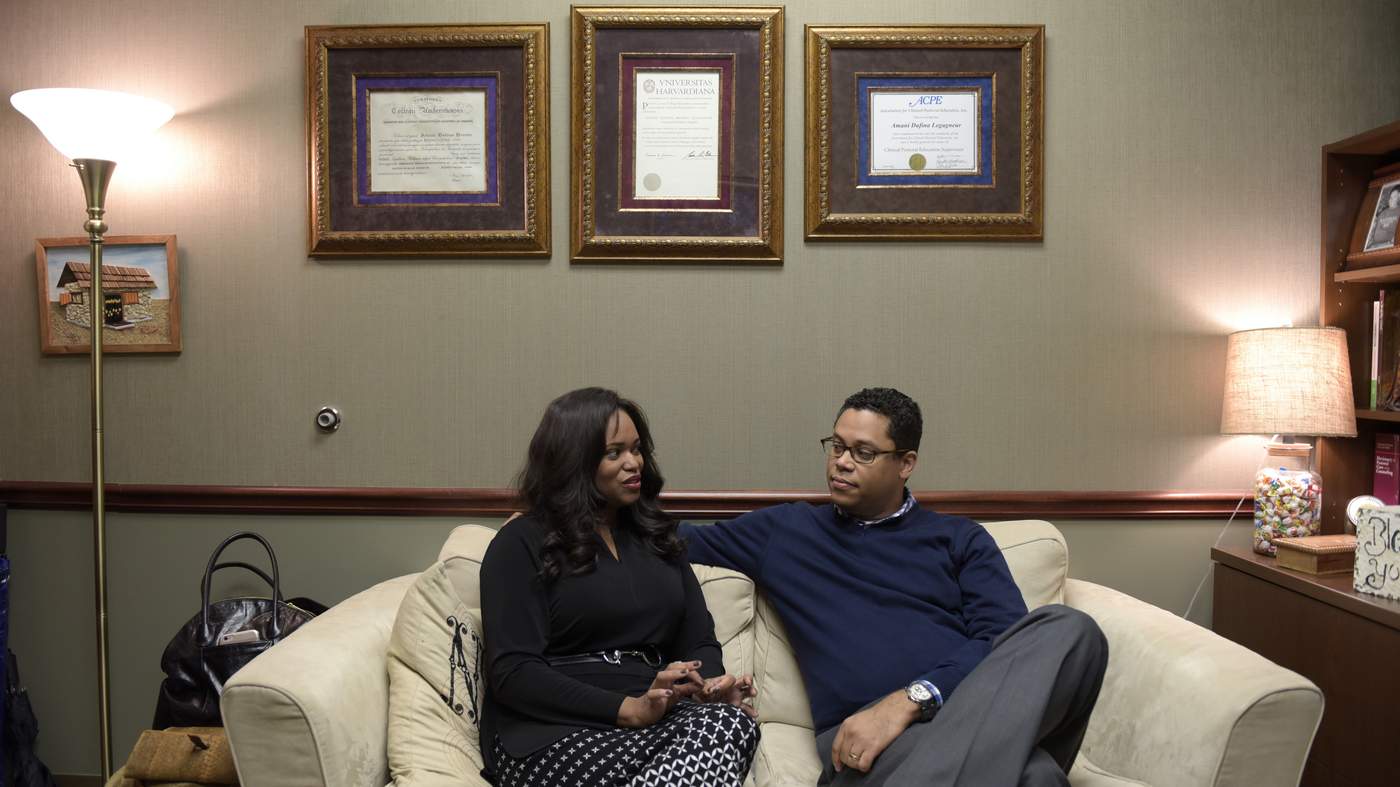
Amani sits with her husband Lionel in her office at Northside Hospital.
4
Strength in weakness
After she graduated from divinity school in 2003, Amani and Lionel moved to Snellville where he got a job practicing corporate law and she entered the clinical pastoral education program at Emory University Hospital. She would still be a healer, just a different kind, she’d decided.
“My mother is a clinical psychologist, my sister is a doctor, and I would be a chaplain,” Amani thought at the time. “The women in our family would be a holy triumvirate of mind, body and spirit.”
Even as she pursued a new life with Lionel in Atlanta, Amani lived in fear her brain might short-circuit again someday. She knew the old symptoms — fatigue, weakness, mental fuzziness — still lingered in the recesses of her being.
One day she was talking with Maureen Shelton, who was director of the clinical pastoral education program at the time, and Amani shared her fears.
Why not play with your imbalances? Maureen suggested. Let those damaged neural pathways be a gift.
A gift. Not a curse. Amani felt a certain lightness as she contemplated this. Could God’s strength really be made perfect in weakness, she wondered?
Amani broke into a sob. Her mind flashed back to that moment in Harvard Square, sitting in her wheelchair, waiting for Lionel and seeing the happy girl in the red poncho walk by. Maybe if she could “play” with her weaknesses, she could create a new model of strength. Maybe she could stretch into a little more sky.
It was a sea change moment for Amani.
“I realized I could surrender to my brain’s idiosyncrasies and not let them define me,” she said.
She believes it’s no coincidence that when she began seeing patients as a hospital chaplain, her first patient was a 24-year-old woman who’d had a stroke.
Amani was also referred to new doctors, including Dr. Samir Belagaje at Emory. She had seen so many neurologists who brushed aside her symptoms that she was almost afraid to see another one. But Dr. Belagaje was different. He diagnosed her with post-concussive syndrome, a brain injury similar to what NFL players develop after too many helmet bashings. He also confirmed she had a clotting disorder that contributed to a propensity for stroke. Since both of Amani’s grandmothers died in their early 40s from presumed strokes, this clotting disorder could help explain their early deaths. It was sobering news. There was likely a genetic component to her medical issues.
The brain is a mysterious organ. It is home to a complex network of billions of nerve cells, and a brain injury can have inexplicable consequences. Some believe people with brain injuries develop a heightened sense of intuition, a deeper connection with their spirituality, even psychic abilities. Amani always knew she was spiritual, but she thought perhaps it had been crowded out by her preoccupation with science. Accepting her brain injury seemed to open up pathways into untapped areas of her brain.
It was also part of her family legacy. Amani comes from a long line of what she calls “spiritually sensitive women.” Her grandmother was a brilliant woman with a photographic memory who “just knew things” before they happened.
“And my mother!” said Amani. “She loves with the energy of a supernova. In fact, her electromagnetic field often becomes so charged when my sister and I come home for a visit that light bulbs, and virtually anything else in our house with an electrical current, blow out. I grew up thinking this was normal.”
Somewhat sheepishly, Amani confided all this to Maureen. She prepared for a skeptical response. None came.
Wow, said Maureen, sincerely. I bet you have some of that energy in you.
Amani was emboldened. “I believe I do,” she said.
Amani and her colleagues often incorporate music into their work to practice listening and interpersonal relationship development. Amani (from left) is joined by chaplains Linda Hendon, Julie Ferguson, Brent Bond and Winston Carter for a demonstration.

Amani, left, holds hands with her mother, Lannie Pryor Brown, center, and her sister, Ashaki Brown, right, as they walk through the halls of Northside Hospital.


Click above to read more of our Personal Journeys.
More Personal Journeys on faith and healing:
On call, Laurie Eynon's first-person account of her path to becoming a hospital chaplain
Faith in Atlanta, a photo essay
Uno the therapy dog, about a four-legged caregiver at Children's Healthcare of Atlanta
ABOUT THE STORY
As a hospital chaplain, Laurie Eynon works with Amani Legagneur at Northside Hospital. The more Laurie learned about Amani’s odyssey, the more she wanted to know. It was such a fascinating journey, Laurie felt compelled to write about it and share it with others who might find inspiration and hope in her story.
Suzanne Van Atten
Personal Journeys editor
personaljourneys@ajc.com

ABOUT THE REPORTER
Laurie Eynon worked as an English teacher, a church youth worker and advertising copywriter before she moved to Atlanta 11 years ago and entered the chaplain residency program at Northside Hospital. Her previous Personal Journey was about the death of her daughter. She lives in Dunwoody with her husband and has two sons and five grandchildren.

ABOUT THE PHOTOGRAPHER
David Barnes is a student at the University of Georgia who has worked on The Red & Black student newspaper as a photographer and photo editor. He has interned with UGA’s Athletic Association and The Atlanta Journal-Constitution, as well as covered the 2016 Paralympic Games in Rio de Janeiro for the Associated Press.
Please confirm the information below before signing in.