


State officials failed to heed warnings about prison doctor
Prison health system put many women at risk. Physician had been lauded for saving Georgia tax dollars.

State officials allowed Dr. Yvon Nazaire to continue treating thousands of Georgia’s female prison inmates despite repeated warnings that he was neglecting inmates in obvious distress, making questionable diagnoses and trying to intimidate those who questioned him, an Atlanta Journal-Constitution investigation has found.
The apparent lack of attention to the warnings, which came from other medical professionals as well as inmates and their families, suggests some decision-makers stood silent while the health of nearly half the 3,500 women in Georgia’s state prisons was put at risk.
“My question is, how many lives were lost because of inaction?”
said Rome attorney Steve Lanier, who interceded on behalf of an inmate after her pleas for medication to deal with persistent fainting spells went unheeded.
Nazaire was placed on administrative leave and ultimately fired from his position as medical director at Pulaski State Prison in September, after a series of AJC stories raised questions about the deaths of nine inmates in his care as well as the accuracy of the resume he submitted when he was hired nine years ago.
But interviews and documents indicate that a host of officials, ranging from prison wardens to Gov. Nathan Deal’s staff, were alerted to concerns about Nazaire at least five years before the newspaper’s disclosures.
In an April 2014 letter to John Mayes, then chairman of the Board of Corrections, Lanier wrote that Nazaire had not only denied Gayle Hibbard her medication but had berated her for requesting it. Along with the letter, the attorney provided New York medical board documents showing Nazaire had been sanctioned for gross negligence in treating emergency room patients before coming to Georgia.
“My concern is that, based on his treatment of non-incarcerated persons listed in the (New York board) document, he is not going to provide the care that any inmate needs at Pulaski State Prison, not just Mrs. Hibbard,”
Lanier, a former Floyd County district attorney, wrote.
In an impassioned letter to Deal in July 2013, the father of an inmate at Emanuel Women’s Facility asked for an investigation of the health care provided at that institution, where Nazaire also had responsibility for the medical unit.
“I’m a concerned father and concerned for other truly sick inmates that need a voice in the matter,” Lin Butler wrote as his daughter, Mitzi, languished in pain with what would turn out to be a ruptured appendix.
And in lawsuit filed in July 2010, a Pulaski inmate described how she was prescribed a dangerous dosage of the drug Calcitrol by Nazaire and then was “harassed” by the physician after her mother, a nurse, contacted the Department of Corrections to complain.

Janet Rice claimed in a federal lawsuit that Dr. Yvon Nazaire prescribed a dangerous dose of a medication while she was an inmate at Pulaski State Prison.
In her lawsuit, which included copies of her medical records and a detailed narrative, Janet Rice listed nine DOC officials as defendants but wrote that
“mostly I ask that Dr. Nazaire not be allowed to practice ’medicine’ on any Ga. DOC inmate.”
Despite the complaints, Nazaire’s personnel file at Georgia Correctional Health Care, the branch of Augusta University that provides physicians and other medical personnel for Department of Corrections’ facilities, references only one disciplinary matter: In 2011, he received a warning for taking the antibiotic Augmentin from the Pulaski pill call room for his private use.
Dr. Billy Nichols, the statewide medical director for Georgia Correctional Health Care and Nazaire’s immediate supervisor, declined to be interviewed for this story and did not respond to emailed questions.
University spokeswoman Christen Carter said she could not address questions regarding what was known about Nazaire until the school, formerly known as Georgia Regents University, finishes the review of Georgia Correctional Health Care it initiated in July when he was placed on leave.
Joan Heath, a spokeswoman for the Department of Corrections, said the DOC does not believe it ignored allegations that inmates’ medical needs were neglected.
“Notwithstanding,” she wrote in an email Friday, “the (DOC) is changing the way that we do business in order to prevent future allegations of negligence or mistreatment.” In that regard, it is partnering with Georgia Correctional Health Care to review the credentials and performance of all health care providers assigned to DOC facilities, she wrote.
‘A boiling kettle’
Psychiatrist William Thorneloe works on a patient’s case at his office in Smyrna. He is among the medical professionals who tried to sound alarms about prison doctor Yvon Nazaire.
Photo: Hyosub Shin / hshin@ajc.com

One of those in the medical field who tried to sound alarms about Nazaire was Dr. William Thorneloe, a psychiatrist who worked at Pulaski for 3½ years before transferring to another prison in January 2012.
“I was concerned about the long-term sustainability of keeping a very heavy lid on a boiling kettle,” he said in a recent interview. “Something was eventually going to go wrong.”
Thorneloe, who at the time was working for a company that contracts with the DOC to provide mental health personnel, said he and Nazaire disagreed on several matters, the most serious being where inmates with serious psychological issues should be placed when in need of monitoring. Thorneloe wanted those inmates in the infirmary. Nazaire insisted they be in the isolation/segregation unit.
Thorneloe said that unit, also known as lockdown, was bad for those inmates, many of whom exhibited self-harming behavior, because they could not be properly observed and were removed from medical personnel.
“The whole thing made no sense to me,” he said. “I was very worried about the safety of patients going into that situation.”
When Thorneloe announced he was leaving Pulaski, he made his feelings known in a memo distributed to a committee that included then-Warden Belinda Davis, as well as Nazaire.
“Safety for mental health patients has deteriorated,” he wrote, noting that one inmate in lockdown had been able to tie a shoe lace around her neck after a previous hanging attempt using torn bed sheets.
Davis, now a supervisor with the DOC, declined to answer AJC questions.
A few days after handing out his memo, Thorneloe said, he was contacted at home on a Saturday night by Nazaire, who wanted to know about another inmate the psychiatrist had placed in the infirmary. Thorneloe said the inmate, who had just arrived at Pulaski, appeared delirious and needed to be watched over the weekend. That did not mollify Nazaire, who was agitated and cursing.
The next week, Thorneloe said, Nazaire ordered that inmates could no longer have access to a room that was used for telepsychiatry.
Thorneloe said Nazaire’s action caused him to leave Pulaski a week earlier than he had planned.
“I felt that if he was that angry and was going to cause that much trouble with patients, I needed to get out of there even quicker,” he said.
Nazaire did not respond to voice mail and text messages seeking comment.
Deaths and emails
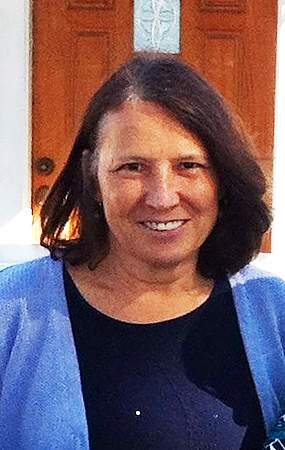
Marilyn Ringstaff, a nurse practitioner who worked for two months at Emanuel Women's Facility, said Dr. Yvon Nazaire repeatedly denied medical consultations for inmates.
The experience Thorneloe described is similar to that of Marilyn Ringstaff, an advanced practice nurse who worked briefly in 2011 at Emanuel Women’s Facility.
In an AJC story in March, Ringstaff said she was fired after she complained that Nazaire rejected her requests to have several seriously ill inmates consult with specialists outside the prison. Two of the women eventually died.

A
Ringstaff provided the AJC with emails she sent to the prison’s warden at the time, Alexis Chase, and to Dr. Edward Bailey, then the statewide medical for Georgia Correctional Health Care, in which she warned that Nazaire was creating a dangerous environment.
In an email Ringstaff sent to Bailey shortly after she was fired, the nurse said she believed Nazaire’s refusal to obtain outside consultations contributed to the two deaths. She also wrote that in a file she had left at the prison she had documented “many other refusals of basic medical care.”
Ringstaff also informed Bailey that Nazaire had admonished her at one point: “You are never, ever to call Dr. Bailey about anything, ever.”
In a recent interview, Ringstaff said she has never been contacted by anyone with Georgia Correctional Health Care or the DOC to discuss what occurred.
“You would think if they had any concerns, they would want to at least hear the other side of the story,” she said.
Bailey, who retired in 2012, has repeatedly refused AJC interview requests and did not respond to an email seeking comment.
Five months after the two deaths, the health services administrator at Pulaski, Betty Rogers, sent an email to Bailey urging that Nazaire be given a raise.
Rogers noted that Nazaire, then being paid an annual salary of $168,300, had doubled his workload by taking on responsibility for Emanuel and added: “He is saving the DOC so much money and goes above and beyond any other physician in the system.”
‘A state of distress’
Lanier’s letter to Mayes was just one facet of a protracted effort by the attorney and others to get better treatment for Hibbard, who has been incarcerated at Pulaski since November 2013.
Before Hibbard began serving her sentence, she was taking three prescription pain medications. The drugs were necessary because Hibbard suffers from syncope — fainting spells that occur without warning — the result of lingering pain from a 1990s car accident, her husband, Randy Hibbard, said.
However, when Gayle Hibbard requested those drugs upon her arrival at Pulaski, Nazaire turned her down. Her husband said Nazaire told her that her only problem was she was “morbidly, morbidly, morbidly, morbidly obese.”
Lanier, who represented Hibbard when she was accused of cruelty to children, said learning of the insult and seeing the New York board documents prompted him to write Mayes, a Rome business owner who has served on the Board of Corrections since 2004.

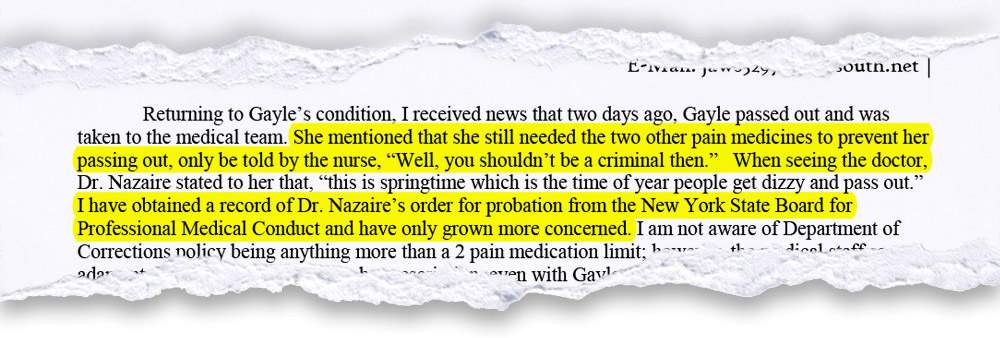
Attorney Steve Lanier’s 2014 letter on behalf of his client, Gayle Hibbard, to then chairman of the Board of Corrections, John Mayes.
“All I know is John and I talked about (Hibbard’s) condition before I wrote the letter,” Lanier said.
“Then when I got this packet of information and heard how her condition had deteriorated and wasn’t being properly handled by the medical staff there, I generated the letter to John, saying, `Look, into this.’”
Lanier said he spoke to Mayes later and was told the matter had been “handled.”
Mayes, who is no longer board chairman, said he usually passes on information he receives from the public to DOC employees. However, he declined to say what he did with Lanier’s letter, saying he doesn’t discuss DOC business with the media.
Randy Hibbard said his wife was allowed to receive one of her pain medications along with ibuprofen. Due to a sympathetic guard, she was also allowed to use a walker, he said. But she continued to struggle with her equilibrium and suffered two black eyes in separate falls.
In an email to the DOC ombudsman in March, Randy Hibbard noted that he was willing to pay for a wheelchair, yet Nazaire wouldn’t give his approval.
“I have been in a state of distress over the treatment of my wife at Pulaski State Prison almost since she arrived there,” Hibbard wrote in the email.
Hibbard said he also discussed the wheelchair with Mayes. Hibbard said Mayes told him in a phone conversation, “It’s prison, man, not the Atlanta Marriott.”
Mayes said he does not remember the comment.
Nichols instructed Nazaire to order the wheelchair in April after being told to do so by DOC medical director Dr. Sharon Lewis, emails show.
“I really feel like I was being ignored, like nothing I said meant anything,” Hibbard said. “I understand there’s a budget, but this is my wife.”
‘Begging’ for an X-Ray
Lin Butler (right) appealed to the governor to intercede when his daughter, Mitzi (left), became ill at Emanuel Women’s Facility. She endured a month of pain before she underwent emergency surgery for a burst appendix.

Butler said he decided to write Deal after learning of his daughter’s condition in a letter from her and a call from an inmate who had just been released. He said his daughter’s letter, while vague, was written in an uncharacteristic scrawl that hinted something was seriously wrong.
“It just sort of said, `I need help,’” said Butler, a Rome security guard who also works part time at a local radio station.
Writing about his daughter’s condition, Butler told the governor: “She’s not asking for medicine but an X-ray because her leg has been in great pain and I worried it may be a blood clot.”
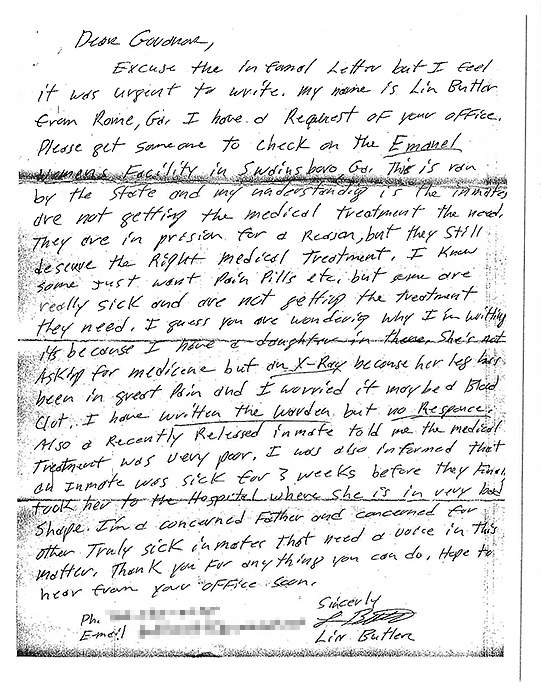
Lin Butler’s letter to Gov. Nathan Deal on behalf of his daughter, Mitzi.
Jen Talaber, a spokeswoman for Deal, said Butler’s letter was forwarded to then-DOC Commissioner Brian Owens.
Owens, now a member of the State Board of Pardons and Paroles, doesn’t remember the matter specifically, but his usual practice would have been to forward such a letter to the DOC medical director, said Steve Hayes, a parole board spokesman.
Mitzi Butler, who was paroled in February after serving two years for methamphetamine possession, said she endured a month of abdominal pain so severe it had her walking bent over and waking up in pools of sweat before she was moved to Atlanta Medical Center.
Emergency surgery there found her appendix had essentially “dissolved.” She said she spent a week in the hospital to clean up the infection.
Recalling her treatment at Emanuel, Mitzi Butler said she was examined several times by a nurse practitioner but never by Nazaire, who was based 80 miles away at Pulaski. Although she was “begging” for an X-ray or an ultrasound, she said, she wasn’t taken seriously until she could barely move.
“It took me being unable to get out of bed at inspection to get to the hospital,” she said.
Complaint and reprisal
In her lawsuit, filed in federal court without legal counsel, Rice detailed how she nearly overdosed on Calcitrol and tried to alert Nazaire’s superiors, only to draw the doctor’s wrath.
Calcitrol is used to treat patients with calcium deficiencies, often the result of damage or removal of the parathyroid glands. An excessive dosage can lead to hypercalcemia, which can cause kidney failure.
In Rice’s case, her medical records show, Nazaire significantly increased her dosage after she transferred to Pulaski in 2009. The records show her blood calcium then spiked to an unsafe level.
As a result, Rice wrote in her lawsuit, she passed out in her dorm room, hitting her head on the concrete floor.
Rice said she described the incident in a letter to her mother, Carol McCauley, and instructed her to contact Guy Hickman, a DOC official who formerly was a warden at Pulaski.
McCauley, a nurse for 30 years, said she read the letter to Hickman.
“He sounded kind of stunned that that kind of thing was happening,” McCauley said.
Rice said she doesn’t know what became of the information after it went to Hickman, who died in 2013, but she believes something was said to Nazaire, because he was hostile and accusatory when she next saw him.
In her lawsuit, Rice’s wrote that Nazaire “started yelling at me and harassing me because he got a call from Sharon Lewis.”
Elaborating in a recent interview, Rice recalled Nazaire saying, “I know you called the state on me. I know your mother talked to them. But it’s not going to do you any good.”
In dismissing Rice’s suit, U.S. District Judge Orinda D. Evans stated that, while “it appears that much could have been done better,” the inmate’s claims did not meet the standard of “deliberate indifference” necessary to seek redress from a governmental body.
Rice, a resident of Bowdon who was released from prison in November 2010 after serving three years for committing offenses that violated her probation, said she believes at the very least she got her point across.
“I just wanted him stopped because he was hurting people,” she said.

More stories, videos and documents on this investigation at myAJC.com
» Deaths of two women inmates put focus on Georgia prison doctor | Bonus web exclusive
» Doctor’s career in New York beset by malpractice death claims
» Women inmates suffer agonizing deaths
» Georgia job application gave false picture of doctor’s career
» Georgia prison doctor placed under review
» Probe of Georgia prison doctor widens
» GA prison doctor fired for lying about work history
» ‘I probably would have died at Pulaski State Prison’
Sherri Cavender, Angela Tripp Watts and Vivian Welker all had easily recognizable and at times gruesome symptoms while they were inmates at Pulaski State Prison. Experts say those symptoms should have merited immediate attention. But that’s not what those women got from the prison medical director, Dr. Yvon Nazaire, and his staff. It wasn’t until each saw doctors outside the prison that they finally learned what was causing their suffering. They had cancer. At myAJC.com, you can read and hear the stories of how three inmates endured the medical care at Georgia’s second largest prison for women and lived to tell about it.
Please confirm the information below before signing in.