


The legacy of Turner Field
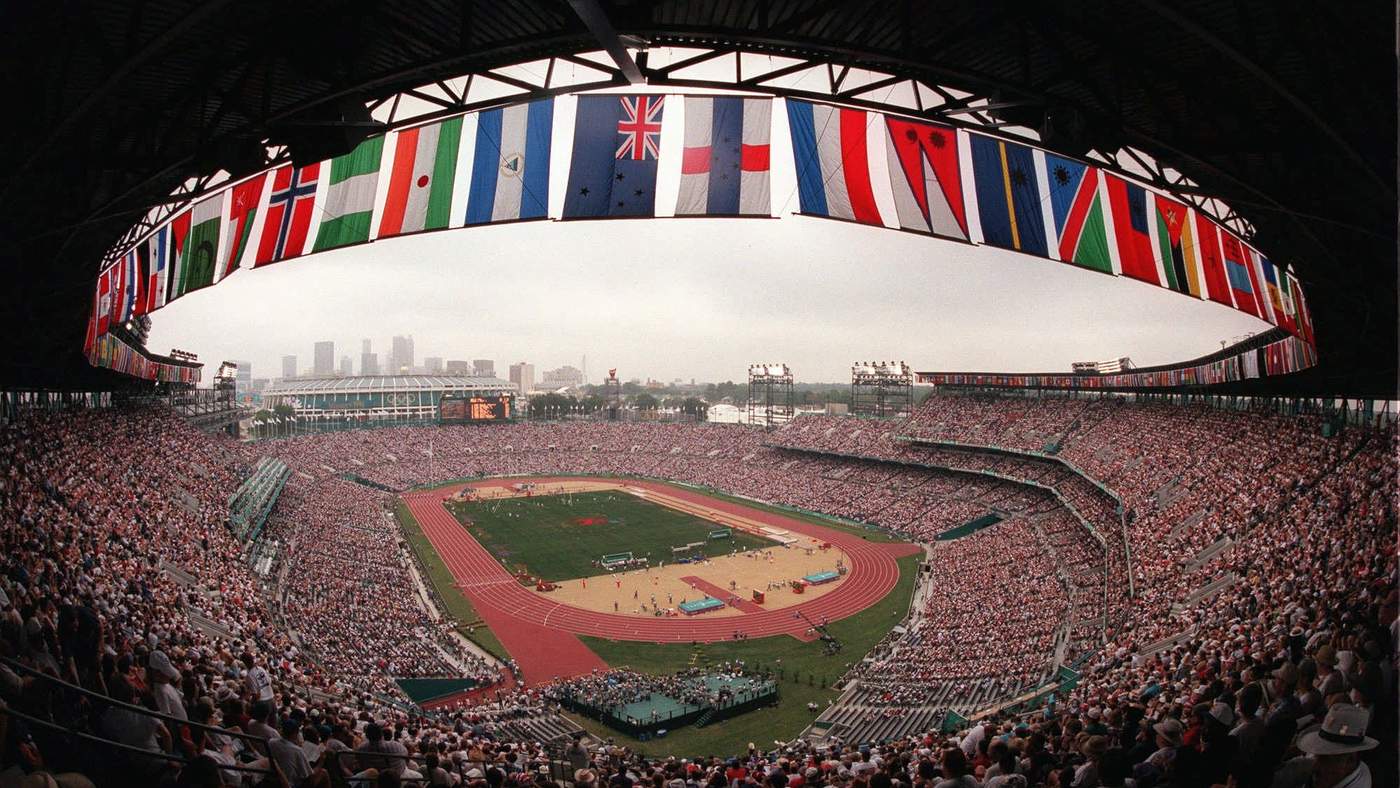

Photo: Chipper Jones hits the 400th home run of his career in the 6th inning of their game against the Florida Marlins at Turner Field on June 5, 2008. Jason Getz / AJC file
And for the past 20 years, the Olympic stadium has been home to the Atlanta Braves, a hive of energy, where a steady stream of tens of thousands of baseball fans filled the brick-and-limestone structure. It’s the place where the Braves won nine of their 14 division titles.
It’s where Greg Maddux, John Smoltz and Tom Glavine continued their dominance as the greatest trio any one rotation has ever possessed.
It’s where Chipper Jones joined an elite group of players when he hit his 400th home run on a summer day in 2008. It’s also where Jones, during his final season in 2012, blasted a two-run walk-off homer in the bottom of the ninth with two outs to give his team a comeback victory 8-7.
And yet …
Turner Field, long cited as the smart way to repurpose an Olympic venue, is closing. When the lease expires after the 2016 season, the Braves are stepping away from Atlanta to take their game to Cobb County. Stadiums, like Olympic flames, eventually go dark.
What does that mean for the legacy of a stadium only 20 years old?
Though the stadium won’t be reduced to rubble, it will gain a new name, a new purpose, a new life.
The iconic Hank Aaron statue at Turner Field (photo by Curtis Compton/AJC) and the Olympic cauldron will also remain in downtown Atlanta although exactly how these historic landmarks will be incorporated into a massive piece of property stretching 67 acres has not yet been decided.
But Turner Field will no longer be home of the Atlanta Braves, no longer a vestige of the Olympics.
Shirley Franklin, former mayor of Atlanta who worked on the Olympic committee, said while she, as a former mayor of Atlanta, would love to see the concentration of professional sports remain in the city, she would refrain from expressing an opinion about the move to Cobb County.
“Certainly the Olympics left an indelible mark on the city and state … and Turner Field was an important part of the memories. I don’t think you can ever erase that, whether it’s knocked down or someone else is using the field. I don’t think the memorable pictures will ever be lost.”
An enviable transition
Atlanta’s Olympic organizers built the Olympic stadium with $200 million of private money from ticket sales and sponsorships. Right after the Games, the 80,000-seat venue was converted into a 50,000-seat baseball stadium.
It was the Olympics’ gift to Atlanta.
Over the years, the Olympics have left behind an ever-growing group of “white elephants” — elaborate ventures, buildings that prove very expensive to maintain, and are sometimes even useless. One recent example includes the seemingly impressive “Bird’s Nest” venue, a grandiose palace of steel built for the 2008 Beijing Olympics (pictured left, in a 2008 photo by Ng Han Guan/AP). It has since been coined “empty nest” because the building sits mostly empty with a smattering of visitors paying about $8 to tour the former Olympic centerpiece.
A recent European study by Leisure Studies publication found no venue built for a major sporting event — which included not only Olympic venues but World Cup stadiums — since the 1996 Olympics has been more effective than Turner Field. Since opening in 1997, Turner Field has averaged close to 30,000 people at about 80 games a season.
Economist Bruce Seaman of Georgia State University said, “It is much easier to recall sad examples: Athens, Sarajevo, ‘Bird’s Nest’ from Beijing … Turner Field was a much smoother transition to a useful facility.”
Braves fans Seaton and Lucille Smith cheer during Atlanta Braves home game against the San Francisco Giants in early June. Photo by Hyosub Shin/AJC

Photo: Mike Plant, Braves president of development, gives a tour of the new stadium to members of the media on May 5, 2016. Photo by Brant Sanderlin/AJC.
What’s next?
Right from the start, even though Turner Field sat less than one block from Atlanta-Fulton County Stadium, which served as the Braves’ ballpark from 1966 to 1996, the ballpark faced challenges.
Turner Field, about 2 miles south of Centennial Olympic Park, is not really downtown — but rather south of downtown. Surrounded, even cut off by highways, the area doesn’t blend into the city. And the communities around Turner Field never flourished as hoped.
The lack of easy access to public transportation was an ongoing, nagging issue. The Braves shuttle was far from ideal. (Though the Cobb stadium will have far more parking, traffic and a lack of public transportation are expected to be issues there, too.)
In addition, the Braves wanted to control and develop city-owned property around Turner Field in hopes of turning it into a mixed-use development that would buzz with activity even when the ballpark is empty.
For now, all indications suggest Turner Field will likely be used as the home of Georgia State’s football team, with the team playing there as early as next year.
Atlanta-based real estate developer Carter and Georgia State University have teamed up on a proposal to redevelop Turner Field and the property around “the Ted” for multiple uses, including football and baseball stadiums, retail, and residential and student housing.
“Atlanta has an incredibly rich sports history. We think this is an opportunity to embrace the sports legacy and integrate the facilities into the community,” said Carter President Scott Taylor. “It’s an incredible opportunity to look forward to be as innovative and creative as we can be, to celebrate the rich past but also look forward with great history.”
Mike Plant, a former Olympian and president of development for the Atlanta Braves, is pleased to see Turner Field get spared by the wrecking ball.
“It has been a great 20-year run for us at Turner Field,” said Plant, who was a member of the 1980 U.S. Olympic Speedskating Team in Lake Placid, N.Y. “And I have this personal attachment to this place. When I put my Olympic cap on, I tell people frequently the accomplishments of the field of play of athletes are timeless and those will never be forgotten. They transcend the venue, because it’s not necessarily the memory of the venue, it’s the memory of the athletic accomplishments and I think you can say the same thing about professional sports … (Turner Field) has been a great legacy. It’s been an incredible venue.”
THE HOME TEAM
This is part of a series of articles looking at Turner Field in its final season and those affected by the Braves’ move to Cobb County next season.
Previous stories
Turner Field neighbors, vendors prepare for life without the Braves.
With the move to Cobb, some Braves fans struggle with change while others are ready for it.
Coming later this season
Behind-the-scenes look at ballpark cuisine and the folks who serve it.
Please confirm the information below before signing in.