


Walker | Diesel
A K9 unit's never-ending mission

23 years in the making
Twenty-three years ago, Sgt. Jason Walker had no idea he would end up with a life companion named Diesel, or that “Bring Your Dog to Work Day” would be, for him, just par for the course.
Walker was 21 when he joined the Atlanta Police Department. That was 1992, and he worked in patrol and narcotics until 2004, when he was transferred to the K9 Unit because that division — whose eight teams cover the city 24 hours a day and go on about 2,000 calls annually— needed a sergeant.
During his 12 years before joining the K9 Unit, he worked with a close-knit four-person narcotics team. But more often than not, at the end of their shifts, they went their separate ways. With Walker’s transfer to the K9 division, all that was about to change.
He still remembers the 11½-hour drive one-way to Miami to pick up Diesel, a black Belgian Malinois that was a puppy named Rudy at the time.
The vendor, a sort of middle man who travels to Europe to pick out potential K9s, had brought back a few choices. Each K9 had to have its own passport booklet, just like a person’s, since the dogs were traveling between countries. Some even had tattoos in their ears to mark their import.
For four or five hours, Walker and his road trip companion tested Rudy and another dog, Chico, in drive and temperament. Walker fell in love with Rudy, who was happy and energetic.
Chico, meanwhile, ended up biting Walker’s left hand so hard the officer had to get stitches.
On the long drive back to Atlanta, an excited Rudy, about 13 months old at the time, never once laid down or went to sleep — Walker thinks he was trying to figure out their final destination. A couple of weeks later, Walker did two important things. He took his dog to the APD vet for blood work, X-rays and a full work-up. And, with the help of his fellow officers, he decided on Rudy’s new name: Diesel.
The dog’s puppyhood was full of mischief, like the time he weaseled his way to the front of Walker’s APD K9 van and stole his McDonald’s Egg McMuffins. Or the time he snuck up there and drank Gatorades and a gallon of water. Or the time he tore a bunch of wires out the back of the van. (It didn’t impair the vehicle’s function, and Walker still doesn’t know what those wires were attached to.)
As Diesel gained experience, he gained maturity. But he didn’t lose his mischievous streak. At the United States Police Canine Association K9 trials in Guntersville, Ala., part of the certification process, Diesel broke away from his handler to dash into a nearby lake.
Training | Work
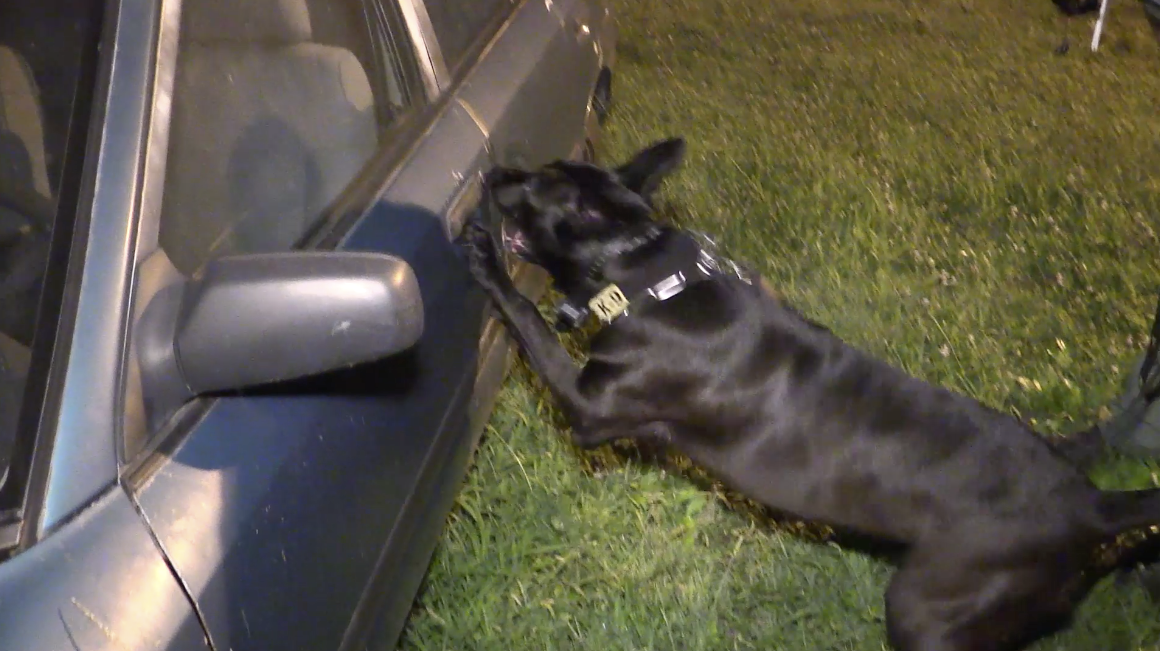
The sky is deep blue on the night of July 8 at the Atlanta Police Department’s K9 training facility. Crickets are chirping, and the shadows of Walker and Diesel are elongated on the pavement. They’re about to enter the field to demonstrate a narcotics detection training session.
Walker reins in Diesel on a short leash, giving him commands in German, the language the dog became accustomed to in Europe. As they walk past equestrian jumps reserved for training the Atlanta Police Department’s horses, Walker asks his partner, “Ready to go work?”
Diesel responds with two barks, and off they go — around and around a white Ford van, circling an APD vehicle, pasta dingy white car with a broken side mirror, and finally straight to a tealsedan. Diesel barks and paws the seam between the doors while Walker becomes giddy with pride. “Good boy! Good boy!” Diesel has sniffed out 15 grams of marijuana.
The bond between officer and K9 is crucial, Walker says, because they must rely on one another. Each dog, as a puppy, goes through a two-week bonding process with its officer. The dog lives with its officer, rides with its officer, and is fed and cared for exclusively by its officer. In short, it learns to look solely to its officer to meet all its needs by the time training begins toward certification as a K9 police dog.
While narcotics training usually lasts 12 weeks, it’s essentially simple. The dogs are raised adoring a specific toy, usually a Kong rubber cone — and in Diesel’s case, a red one. The officer hides the toy, and the K9 becomes a master at finding it. Next, the officer hides drugs and the toy together. The K9 becomes skilled at finding both. Then comes the curveball: the officer hides the drugs without the toy. The K9 finds the drugs due to association, then gets rewarded with its beloved toy.
Officers are able to certify some dogs in the midst of their training, while other K9s have to complete the entire process before they qualify. And certification is crucial. Without it, any evidence uncovered by a police dog would be inadmissible in court.
Diesel was trained in June 2006, and Walker says the process was easy. Diesel is a great, high-energy working dog, Walker says, and after nine years together the two act as a cohesive unit on autopilot.
In 2012, when Diesel was 7, he learned more crime-fighting skills when Atlanta’s new police chief decided that dogs originally trained to perform a single function — narcotics tracing — would be additionally trained to track humans and locate missing evidence, such as weapons.
Diesel learned two new jobs in a matter of six or seven weeks, when he earned his certification at age 50 in dog years. Apparently you can teach an old dog new tricks — ones he can use to help solve a murder.
Fatal shooting
On a chilly day in late March of last year, Walker, in response to a shooting, drove to I-20 near the intersection with I-285.
Police had arrived on the scene at 3:40 p.m. and closed off two lanes of I-20 to search for the gun. But they soon realized they needed the K9 Unit’s help.
That’s when Walker and Diesel got the call.
According to news reports, Cory Jones, 29, and his girlfriend, Twyanna Boyd, 25, had been arguing in Boyd’s silver sedan as she drove near the Westside Perimeter. After she pulled over onto the left shoulder of I-20 and got out of the car, Jones allegedly shot her in the back as she walked away. Passersby called 911, and Boyd died a short time later at Grady Memorial Hospital.
Jones told police that another driver he knew had been following them. That driver, however, had an alibi — he said he was in a meeting at the time of the shooting. When authorities determined he was telling the truth, Jones changed his story and said he shot Boyd accidentally.
It was almost 5 p.m. when Walker and Diesel arrived on the crime scene to search for a weapon. Diesel scanned the nearby woods for 15 or 20 minutes before signaling, by lying down in some tall kudzu, that he’d found something. Walker checked, and the grass revealed a .357 Smith & Wesson revolver.
Jones was convicted on murder charges and sentenced to life in prison without parole plus 10 years. And Walker remains proud of the role Diesel played in closing the case.
“I get just as excited as he does,” Walker said. “Obviously finding the gun … is a big deal. And we’re able to take it off the street, so it’s a big deal, like I said. With all the work that goes into training these dogs, when they do find something it’s definitely rewarding for me, obviously, as a handler who trains him.”
Home Life
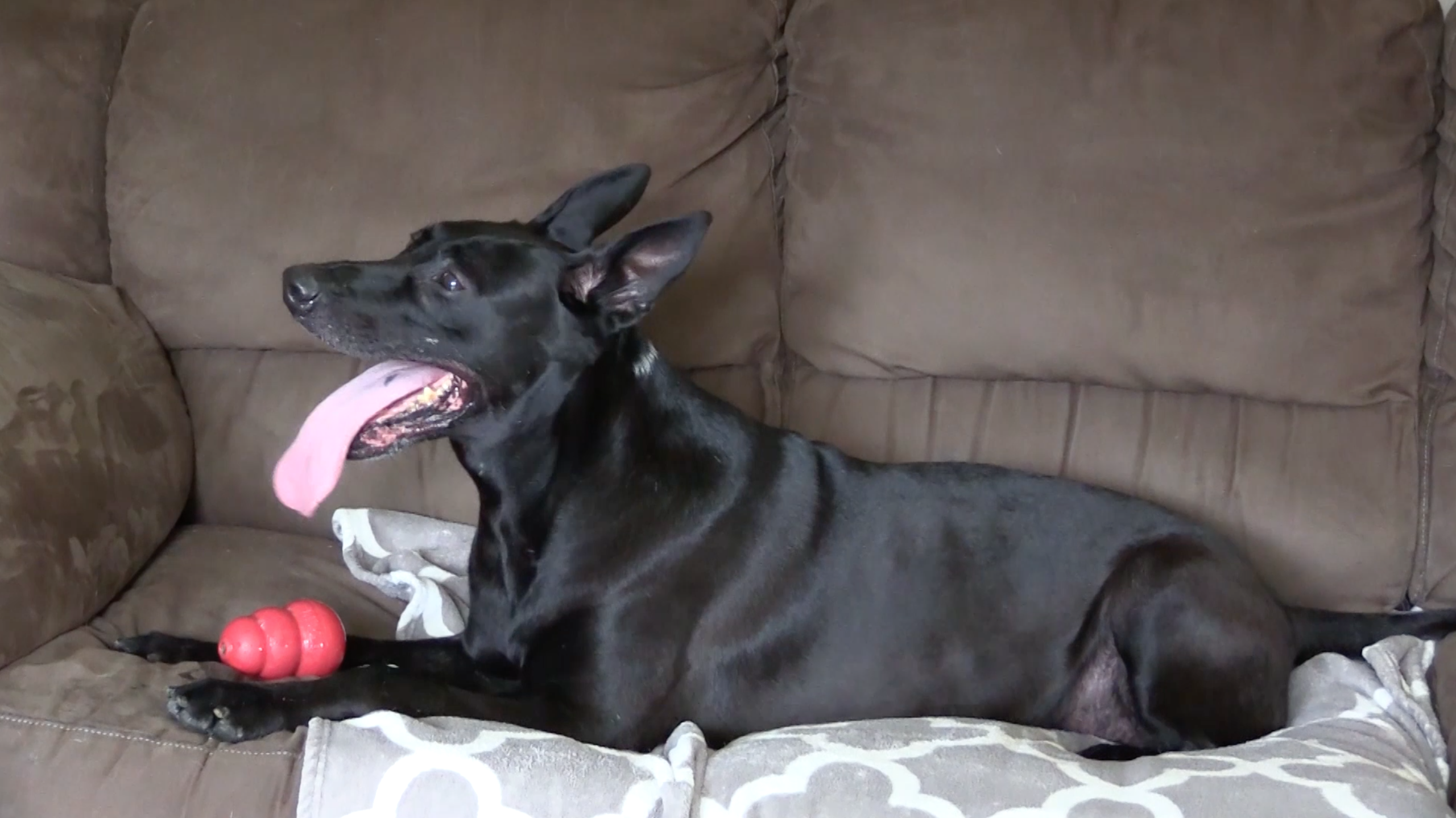
In Powder Springs, Walker parks his police car on the grass next to the driveway, and he and his canine shadow enter a cream-colored house with dark red shutters. Photos of his niece and nephew are on the wall, and a brown suede couch sits prominently in the living room, Diesel’s favorite haunt.
Diesel lies on the couch as comfortably as if he were a part of it, his long, pink tongue lolling out of his mouth. His red Kong toy is between his black paws, and he can’t go long without clamping it between his teeth and rearranging it in his mouth. Walker laughs. “To be a working dog, you’ve gotta be a little bit crazy,” he says.
At night, Walker and Diesel typically relax by watching television — usually FOX News or ESPN — Diesel’s head resting on Walker’s stomach or leg.
In the morning, Diesel wakes up on the floor next to Walker’s bed and tries to wake up his handler: nudging him with his nose, licking him in the face or hooking his head under Walker’s arm.
At home, Diesel is docile and at ease. But when he sees Walker put on his uniform or hears the unmistakable sound of Velcro, he gets excited and knows it’s time to go to work.
Not all K9 officers have a partner that can down-shift into chill mode as easily as Diesel. Take Brittney Fisher, another one of eight handlers in the Atlanta Police Department’s K9 Unit. Her partner’s name speaks for itself: Ruckus.
On the morning of their first full day together, Fisher heard crashing and commotion outside. She rushed to the window and looked out to find Ruckus flinging his metal water bowl all over his kennel’s concrete floor and fence. “He was just having a good time,” Fisher said, laughing at the memory. When she bought him a rubber water bowl, the same thing happened. Her final solution? She got a friend to build a concrete 5-gallon water bucket that the dog can’t destroy.
The now 4-year-old Ruckus has calmed down some since that first day, but he still lives up to his name. While there’s a huge fenced-in area at Fisher’s house in which Ruckus can run and play, he usually stays in a crate at home because, unlike Diesel, he can’t switch off. Ruckus is at 100 percent, 100 percent of the time. “He doesn’t know what ‘chill out’ means unless he’s in the crate,” Fisher said.
For each K9 police dog, the city builds a 10-by-20-foot kennel in the yard of each handler’s home. But Fisher, like Walker, prefers to keep her dog in the house.
When he’s in his crate, Ruckus plays something Fisher’s husband calls “the boo game.” When someone walks by his crate to get to the pantry or laundry room, Ruckus lies in wait until they reach the front of the crate, then barks up a storm.
The game isn’t limited to the crate, though. Ruckus will also do it when he’s in the truck to catch people by surprise.
When Fisher first partnered with Ruckus, she says he was more of a “dude dog” — used to being handled by men only. But he’s a “chick dog” now. He loves Fisher and her sisters, and when her husband hugs Fisher in the kitchen, Ruckus loses his mind.
Today's journey
As sergeant, Walker is responsible for ensuring the dogs’ training, guiding the handlers’ decisions and communicating the eight teams’ schedules.
At the annual K9 Unit trials, Walker says people pull him aside and ask why his team of officers is so close. But he doesn’t really have an answer. “We just are,” he says. “When you see one of us, you see all of us. And we like to roll around like that.”
Diesel, meanwhile, has become a veteran in his field. With close to 2,000 searches under his belt, Walker can see how far his partner has come in the past nine years. Their relationship has progressed to a point where they can focus all their energy on the search. They know each other, they know the routine and their level of trust is palpable.
“We’re like an old married couple,” Walker says. “We argue all day long. He just wants to be up here (in the truck) lickin’ on me and lovin’ on me. … Oh, he’s such a baby.”
Please confirm the information below before signing in.